Are you a Federal or Commercial security professional struggling with “black-box” software risks? Security engineers often face:
Hidden Vulnerabilities
Invisible threats lurk within compiled code without source code access
Manual Bottlenecks
Analysis and reverse-engineering move slower than the adversary
Reporting Gaps
Public disclosures lack key data to pinpoint critical vulnerabilities
AARDVARK automates vulnerability discovery to illuminate hidden threats and secure your software.
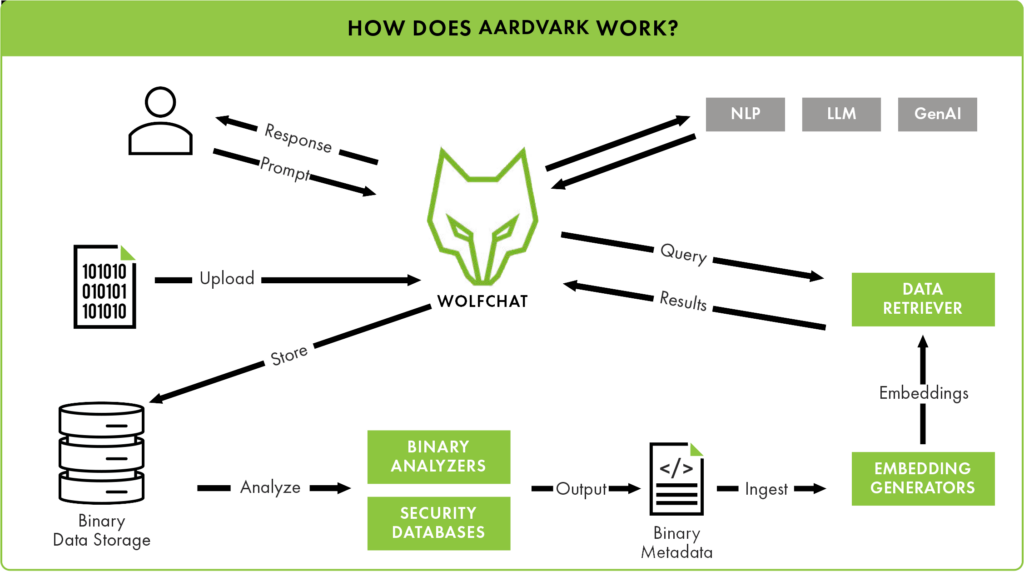
The AI-Assisted Reversing, Discovery, Vulnerability Analysis, and Remediation Kit (AARDVARK) leverages Natural Language Processing (NLP), Large Language Models (LLMs), Generative Artificial Intelligence (GenAI), and Machine Learning (ML) to perform AI-driven, static vulnerability analysis of binaries. This cutting-edge approach, which extends the proven capabilities of Dark Wolf’s internal LLM platform (WolfChat) and Saving Throw, aims to identify zero-day and N-day security vulnerabilities, ultimately improving the overall security posture of software and systems.
Features and Benefits
Scalable binary analysis and summarization of different file formats (ELF, PE, Mach-O), architectures (x86/x64, ARM/ARM64, MIPS, PPC), Android Package Kits (APK), iOS Package Archives (IPA), and firmware binaries.
Zero-day vulnerability identification through the integration of Saving Throw, Dark Wolf’s proprietary automated static binary analysis tool.
Comprehensive reporting of known flaws through the automatic comparison of software binaries with the National Vulnerability Database (NVD) to identify N-day vulnerabilities.
Actionable remediation guidance and reporting through the provision of automated analysis and summaries at scale.
Flexible, low-overhead deployment through its Modular Open Systems Approach (MOSA) design that runs in the cloud, local, and air-gapped environments.
The Dark Wolf Difference
Unlike other COTS software products, AARDVARK is an innovative, affordable, and effective solution that applies cutting-edge AI technologies for static binary analysis. This is demonstrated by its use of a specialized adaptation of GenAI within the WolfChat platform to extract binary features, process data into a vector database, and provide quick retrieval by the LLM to answer user questions about the binary.
Customer Successes
During a recent security assessment of Android and iOS apps, AARDVARK slashed manual testing time from 40 hours down to 8 hours. This 80% increase in efficiency allowed our team to move beyond surface-level checks. By leveraging AARDVARK’s AI-driven deep-scan capabilities, we successfully uncovered and proved critical vulnerabilities, including an iOS buffer overflow and exposed Java exec() methods, that traditional manual assessments often miss.
Dark Wolf’s AI-Assisted Zero-Day Vulnerability Discovery